Bridal Robes and Dressing Gowns: How to Choose
Share
Robe or dressing gown?
They are the same garment. The wedding industry calls it a bridal robe because the industry learned its vocabulary in America. In a British house it is a dressing gown, and your mother will call it that at the hotel on the morning.
We mention it because you will search both words and find different shops, and because almost everything written about choosing one was written for an American bride buying American satin. None of it accounts for a British spring morning in a hotel room with the heating on too high and four people working around you.
So here is the British version.
What the robe actually has to do
Two things, and they pull in opposite directions.
The first is that you will be in it for three to five hours. Hair, then makeup, then the photographer arriving, then waiting, then the bridesmaids, then more waiting. It is not a ten minute prop. It is the garment you work in.
The second is that it is, after the dress, the most photographed thing you will wear all day. The getting ready sequence is a fixed part of every wedding gallery, and in most of those frames you are in the robe.
Most guides only address the second. They tell you what looks good in a picture and forget that you have to sit in it while someone pins your hair for ninety minutes.
Length: the number nobody gives you
Short, knee length and floor length all get recommended, which is not helpful. Here is the practical rule.
A robe looks shorter once it is wrapped and tied than it does on the hanger, because crossing the fronts pulls the hem up at an angle. A robe that measures knee length flat will sit above the knee on you, and it will ride further when you sit down in a makeup chair.
Measure from the base of your neck to where you want the hem to fall, and look for at least that, then add a little. For most people, a floor length or near floor length robe is the one that photographs well and stays decent when you sit, cross your legs, reach for a coffee and stand up again. A short robe spends the morning being adjusted.
Sleeves, which nobody writes about and everybody regrets
Wide, dramatic sleeves photograph beautifully and get in the way of every single thing that happens that morning.
Someone is going to be working close to your face for two hours. A sleeve that falls forward when you lift your arm will land in the makeup, catch on the curling tongs and dip into the champagne. If you love the look of a wide sleeve, fine, but know that you will be pushing it back all morning, and tell your hairdresser in advance.
Why everyone says satin, and why it is not automatic
Almost every bridal robe guide recommends satin or silk. There are reasons, and there are reasons to think twice.
Satin creases, and it creases in a way that shows. An hour in a chair puts fold lines across the lap and the back, and those lines are still there when the photographer starts. Satin also slips, so the shoulder that looked elegant in the first photograph has slid by the twentieth. And a high shine blows out under a flash, which is exactly the light a photographer uses in a hotel room with poor windows.
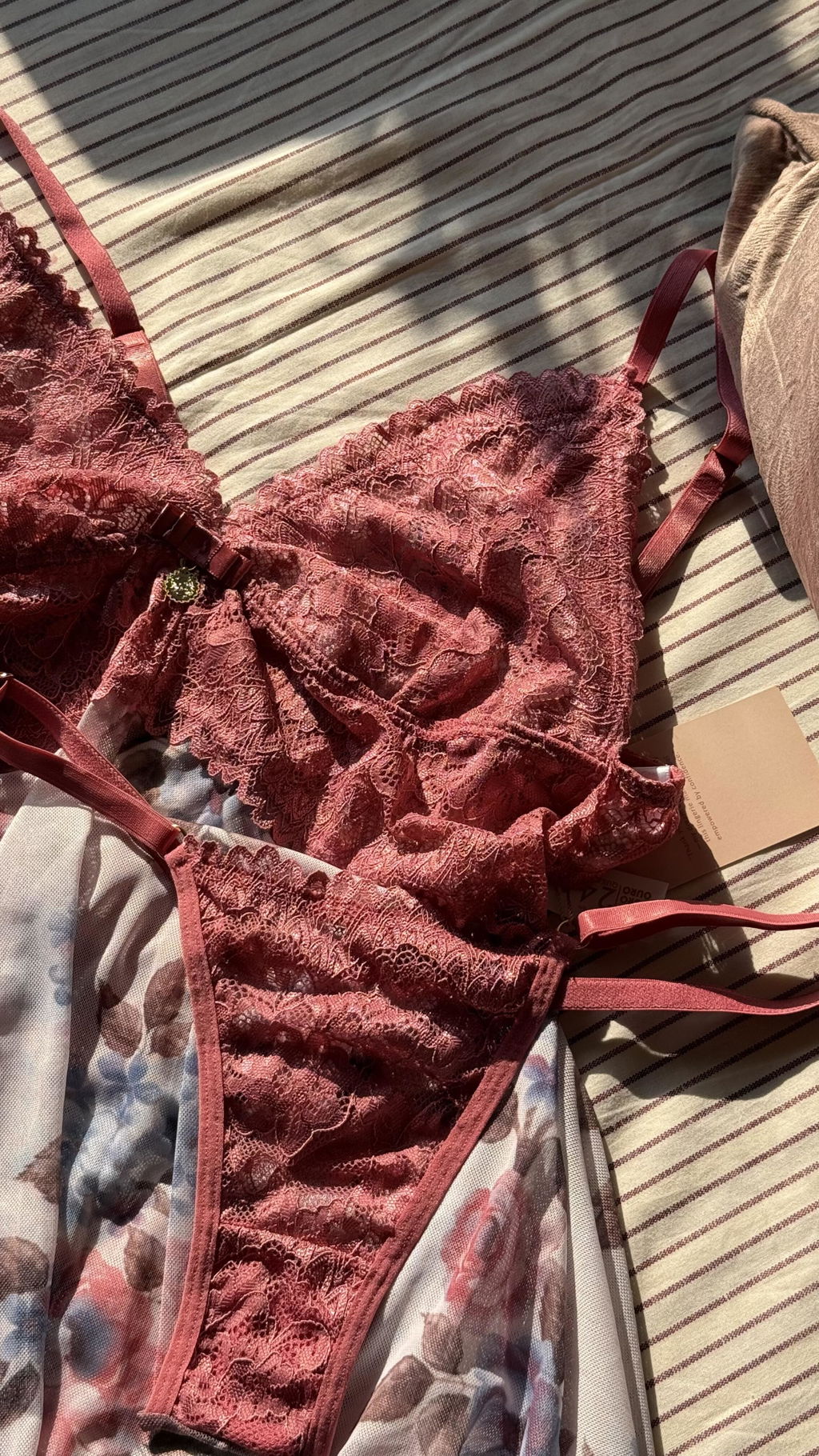
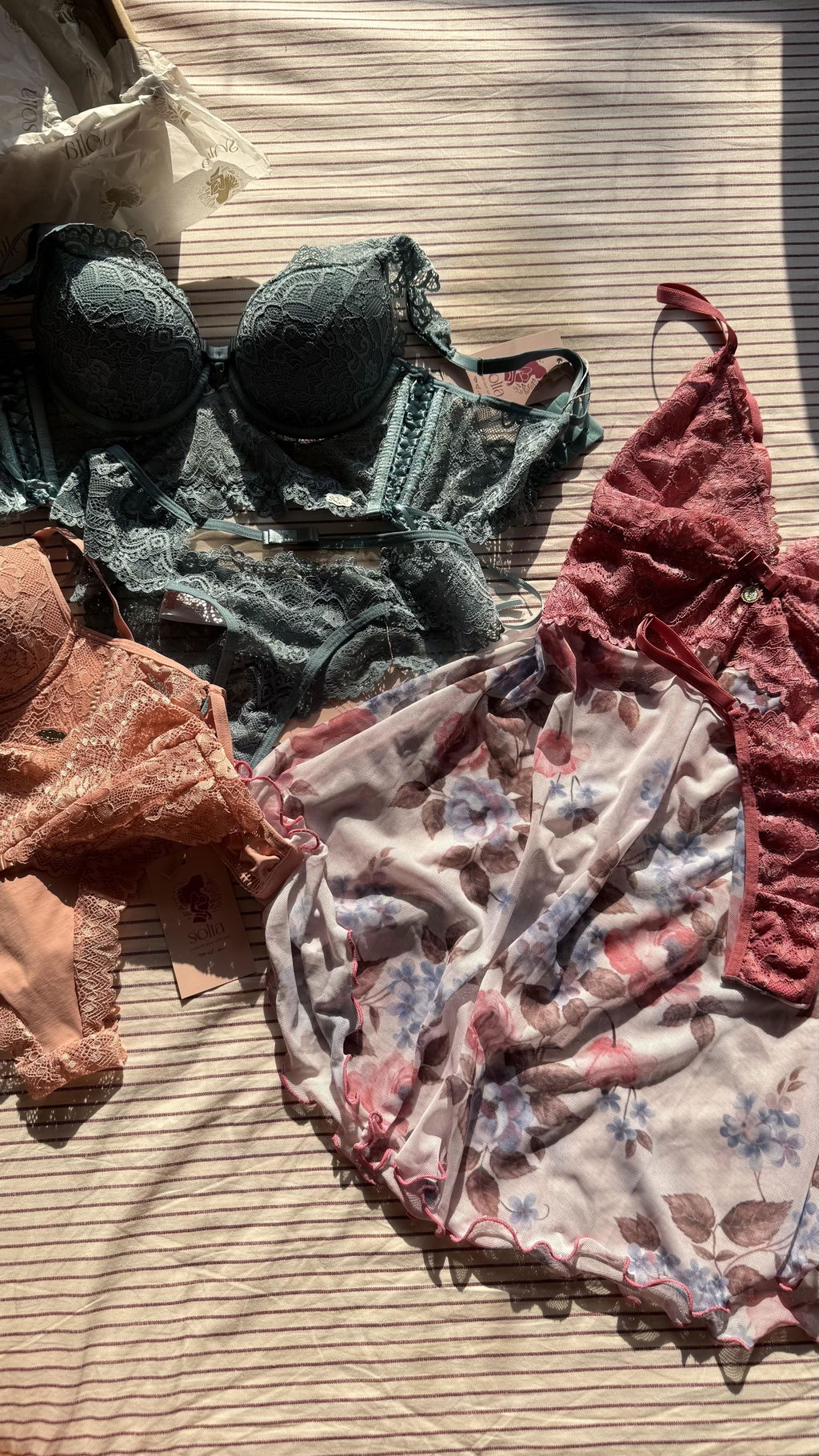
Woven, textured fabrics behave differently. Tulle and lace do not hold a crease the way a flat weave does, they sit where you put them, and they diffuse light rather than bouncing it. That is the thinking behind our own bridal robe, which is tulle and Chantilly lace rather than satin. Lighter to wear across a long morning, and it does not arrive at the ceremony wearing the shape of the chair you sat in.
If you love satin, buy satin. Just hang it the night before, and expect to be smoothed.
Lace is sheer, and that is a decision rather than a fault
Most guides say a lace robe is see-through, flag it as a warning and move on. That is only half the information.
Ours is sheer. Tulle and Chantilly lace are sheer by nature, and pretending otherwise would be silly. What that means in practice is that what you wear underneath is part of the picture, not hidden by it.
Which is usually what a bride wants anyway, because those photographs tend to be the ones where you are getting into the dress. A matching set underneath reads as deliberate. A mismatched everyday bra under a sheer lace robe reads as an accident, and you will see it in the gallery for the rest of your life.
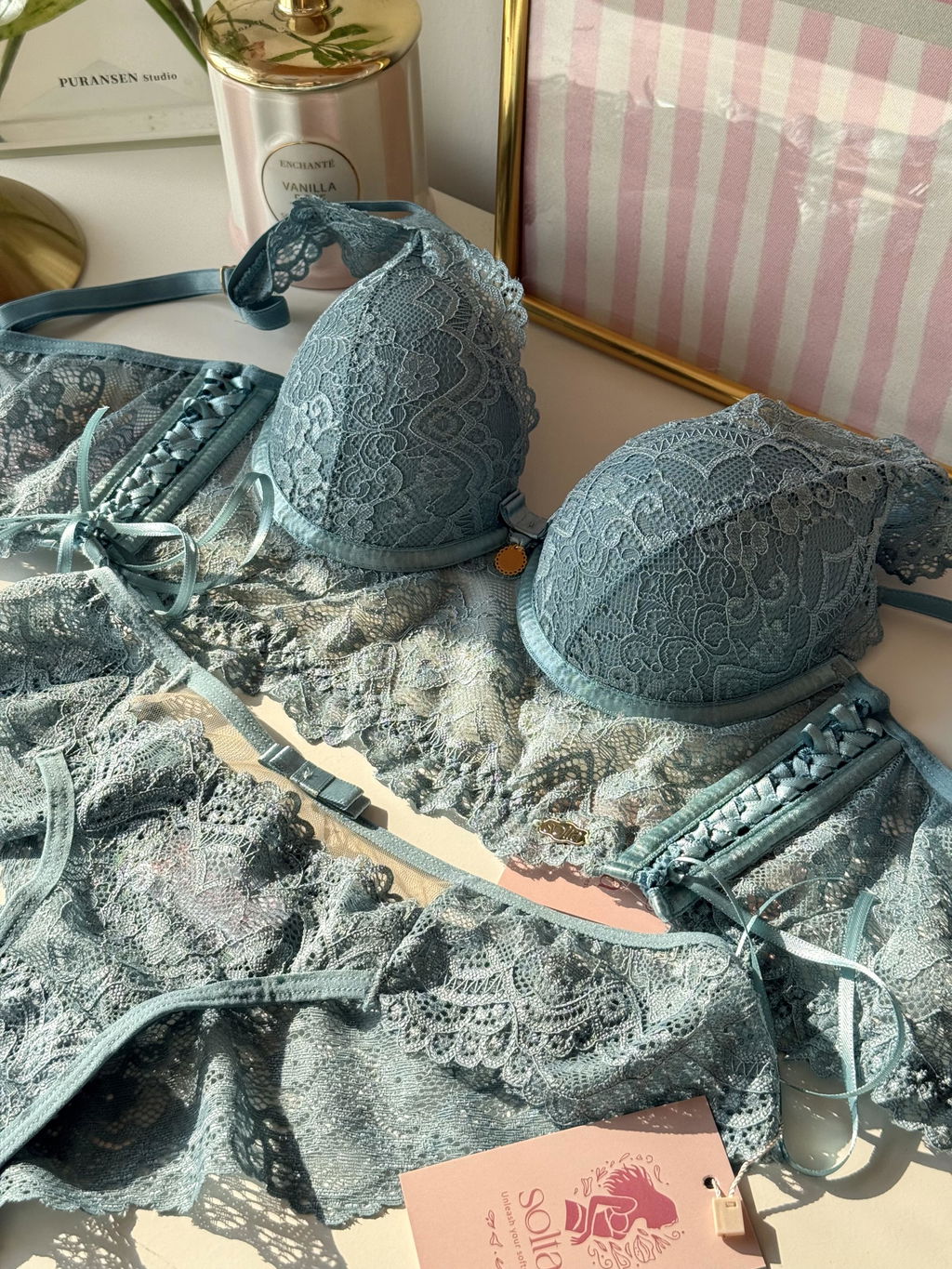
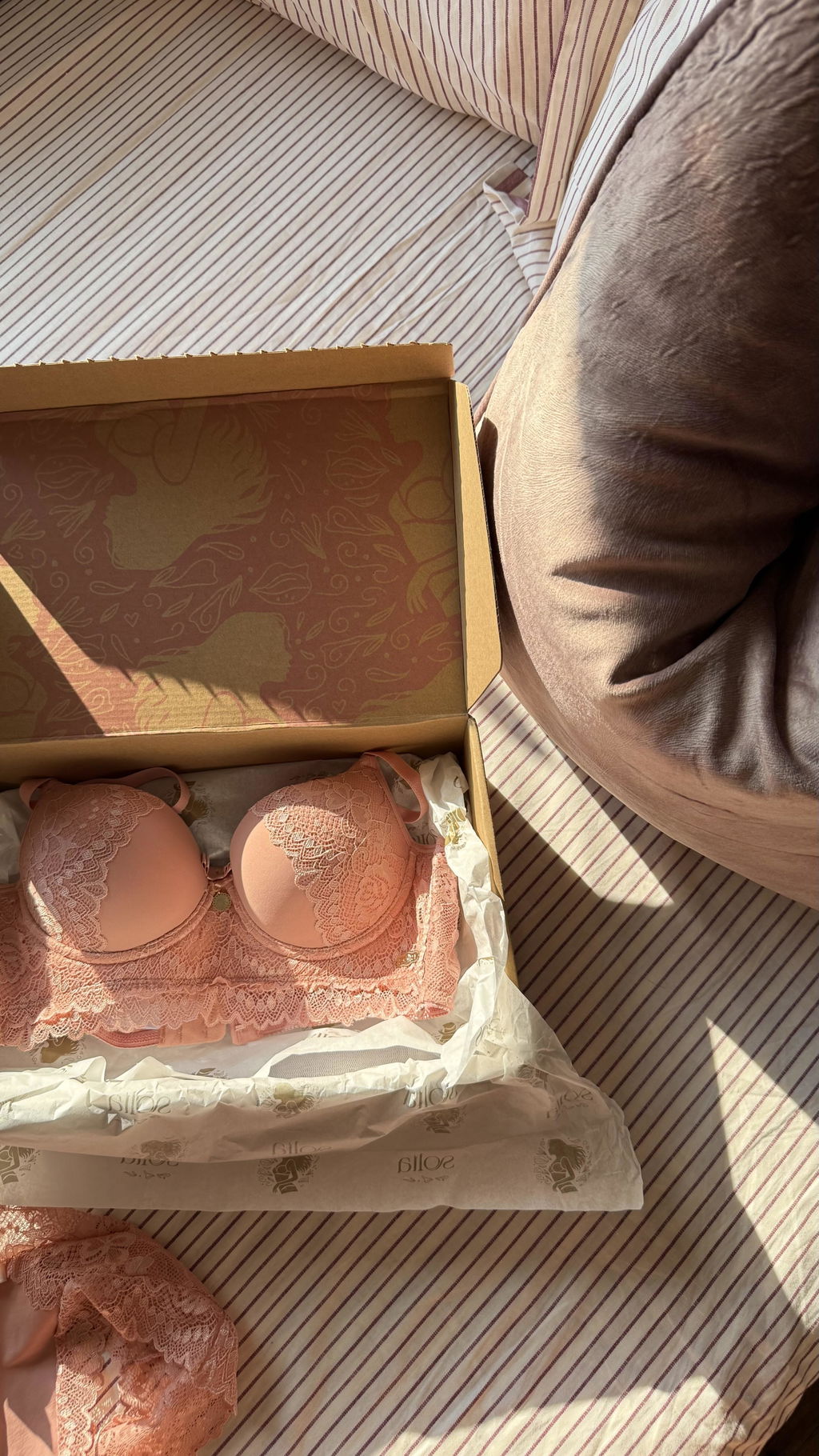
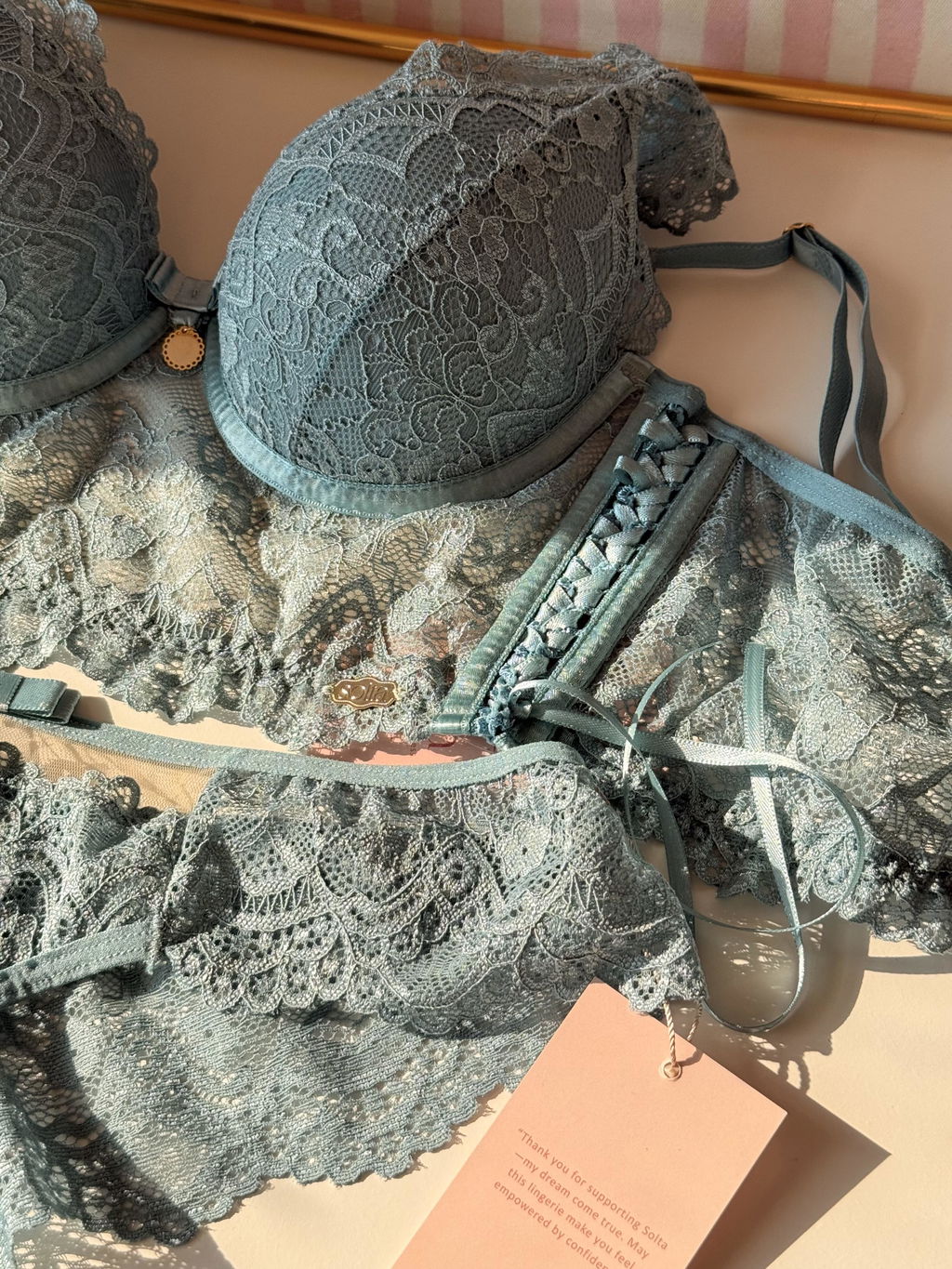
So decide it early, at the same time as the robe, not on the morning. We wrote a full guide to what to wear under a wedding dress, and the pieces live in wedding underwear and bridal robes.
If you would rather not think about it, the answer is an opaque robe, and there is nothing wrong with that.
White, ivory, or something else
White is the obvious choice and it is a good one, for a simple reason: it is the only morning of your life where you are supposed to be the one in white, and the photographs read instantly.
Two things to know. If your dress is ivory rather than white, a bright white robe sitting beside it in a photograph will make the dress look slightly yellow by comparison. It is a small thing, and most people never notice, but photographers do. Second, if the bridesmaids are in a colour and you are in white, the frame organises itself without anybody arranging it.
About matching bridesmaid robes
This is a genuine fork in the road and it is worth being honest about it.
Matching robes for the whole party is its own market, and it runs on personalised satin at around twelve to twenty pounds a piece, because you are buying five or six of them. That is a sensible way to spend that money and we are not going to pretend otherwise.
It is a different purchase from the one robe you wear yourself, which you will have on in the close photographs and which you may well keep. We make the second kind. We do not make bridal party packs, and if that is what you need, buy it from somebody who does.
What to check before you buy, if you are in the UK
Most of the advice online is written for American sizing, so check these.
| Check | Why it matters |
|---|---|
| UK size, not US | A US Medium is not a UK Medium. Find a real conversion before ordering |
| Where it ships from | A robe posted from outside the UK can land you with customs charges and a wait you did not plan for |
| Delivery date against your fitting | Order it early enough to wear it once before the day |
| Opacity | Hold it up to a window. Decide what goes under it now, not on the morning |
| Sleeve width | Lift your arm in it. Watch where the sleeve goes |
Ours runs S to XL with no fitting, and our size guide converts to UK, EU and US sizes. It is made in Brazil and ships from East Sussex, so there is no customs surprise and no four week wait.
Wear it before the wedding
This is the advice most often skipped and it costs nothing.
Put the robe on for a full evening at home, a few weeks before. You will find out whether the sleeve annoys you, whether the tie sits where you want it, whether it is warm enough for the room you will actually be in, and whether it needs steaming. Finding any of that out at eight in the morning on the day, with a photographer already in the room, is a bad time to find it out.
And afterwards
A wedding dress goes into a box. A dressing gown does not have to.
This is the one piece from the whole day you can keep using, which is worth remembering when you are deciding how much to spend on it. If you buy something you would be happy to wear on an ordinary Sunday, you will wear it on ordinary Sundays, and the wedding becomes something that happens to be attached to it rather than the only reason it exists.
Ours sit in wedding underwear and bridal robes, in white tulle and Chantilly lace, alongside two long nightgowns in the same lace for the night that follows.