What to Wear Under a Wedding Dress
Share
Every guide gives you the same three rules
Wear nude, not white. Wear seamless. Bring it to your fitting.
None of that is wrong. It is just not specific enough to be useful, because it treats every wedding dress as the same object. A crepe column and a tulle ballgown are not the same object. One of them will show the edge of a knicker from across a room, and the other will hide a full bridal corset without blinking.
So this guide starts somewhere else. Not with what you should wear, but with what your dress is made of, because that is the thing that decides the answer.
Why “seamless” is the wrong word for what you actually want
Every bridal guide says seamless. Almost none of them say what a seam has to do with it.
Here is the part that gets skipped. The line you can see under a fitted dress is not usually the stitching. It is the edge, which is the point where the fabric stops and your body carries on. A bonded edge, the kind sold as seamless, is glued rather than sewn. It still has to grip, so it still compresses, and because glue needs surface area to hold, a bonded edge is often wider than a stitched one. A wider band of compression makes a wider shadow.
We wrote about this in detail in what actually causes VPL, and it is worth saying plainly here: our knickers are not seamless. They are stitched in the traditional way. We are not going to tell you they vanish under everything, because no knicker does.
What changes the result is not whether the edge is glued or sewn. It is where the edge sits on you. A Brazilian cut puts the leg line on the fullest part of the hip and the back, rather than cutting across it. There is less flesh for the elastic to push against, so there is less to see. That is a cut decision, not a construction trick, and it is the one thing worth looking for.
Start with the fabric of your dress
Ask your boutique what the dress is made of before you buy a single piece of underwear. The answer narrows everything.
Crepe
Crepe is the hardest fabric in bridal. It is matte, it is fluid, it skims rather than holds, and it has no pattern or shine to break up a shadow. Crepe shows edges, waistbands, lace texture and the outline of anything moulded.
Under crepe, go for the smoothest thing you own in a single flat fabric. Microfibre rather than lace. A Brazilian cut rather than a short or a high-leg brief, because a brief cuts straight across the widest point. Many brides end up in a thong under crepe, and if that is comfortable for you across a fourteen hour day, it is the cleanest answer.
Satin and mikado
Satin has a sheen, and sheen is both a help and a problem. It bounces light, which breaks up soft shadows, so small texture tends to disappear. But it also pulls tight across curves, so a hard edge still reads.
Under satin you can get away with a little lace on the bra, where the dress is not skimming, and you should still keep the knicker flat and smooth.
Lace, tulle and anything with texture
This is the easy category and nobody tells you so. Lace over tulle, beading, appliqué, ruching and layered skirts all break up the surface so thoroughly that almost nothing shows through. If your dress is a lace A-line, you can stop worrying about lines and choose on comfort instead.
Structured and corseted dresses
Many bridal gowns are built with boning, cups and an internal corselet. They are engineered to hold you up without help. Put the dress on at your fitting with no bra at all before you buy one. A surprising number of brides find they do not need one, and a bra under a built-in corset usually creates a second set of lines rather than more support.
A short table, because this is easier to see than to read
| Your dress | What it shows | What to wear |
|---|---|---|
| Crepe | Everything. Edges, texture, waistbands | Smooth microfibre, Brazilian cut or thong, no lace |
| Satin or mikado | Hard edges, not fine texture | Smooth knicker, lace on the bra is fine |
| Lace, tulle, beaded | Very little | Choose on comfort, wear what you like |
| Structured or corseted | A bra you did not need | Try the dress with no bra first |
| Backless or very low back | Any band at all | Adhesive cups, or nothing, decided at the fitting |
Nude is not a colour, it is a relationship
The standard advice is to wear nude rather than white, and that advice is right. The reason usually given is that white underwear sits denser than the dress fabric and reads as a bright panel in photographs, which is true.
But the more useful way to think about it is this. Underwear disappears when there is no contrast between it and your skin, not when it matches your dress. That is why a single beige is not a universal answer. Nude means your tone, and your tone is yours.
We should be straight with you about our own limits here. Our wedding underwear comes in one nude, and it sits in the lighter to medium range. If your skin is deeper than that, the principle still holds and it still matters, you simply need to buy it from someone whose shade range reaches you. We would rather say that than sell you the wrong thing for the most photographed day of your life.
The bra, and whether you need one at all
Work it out at the fitting, in the dress, not in a shop two months earlier.
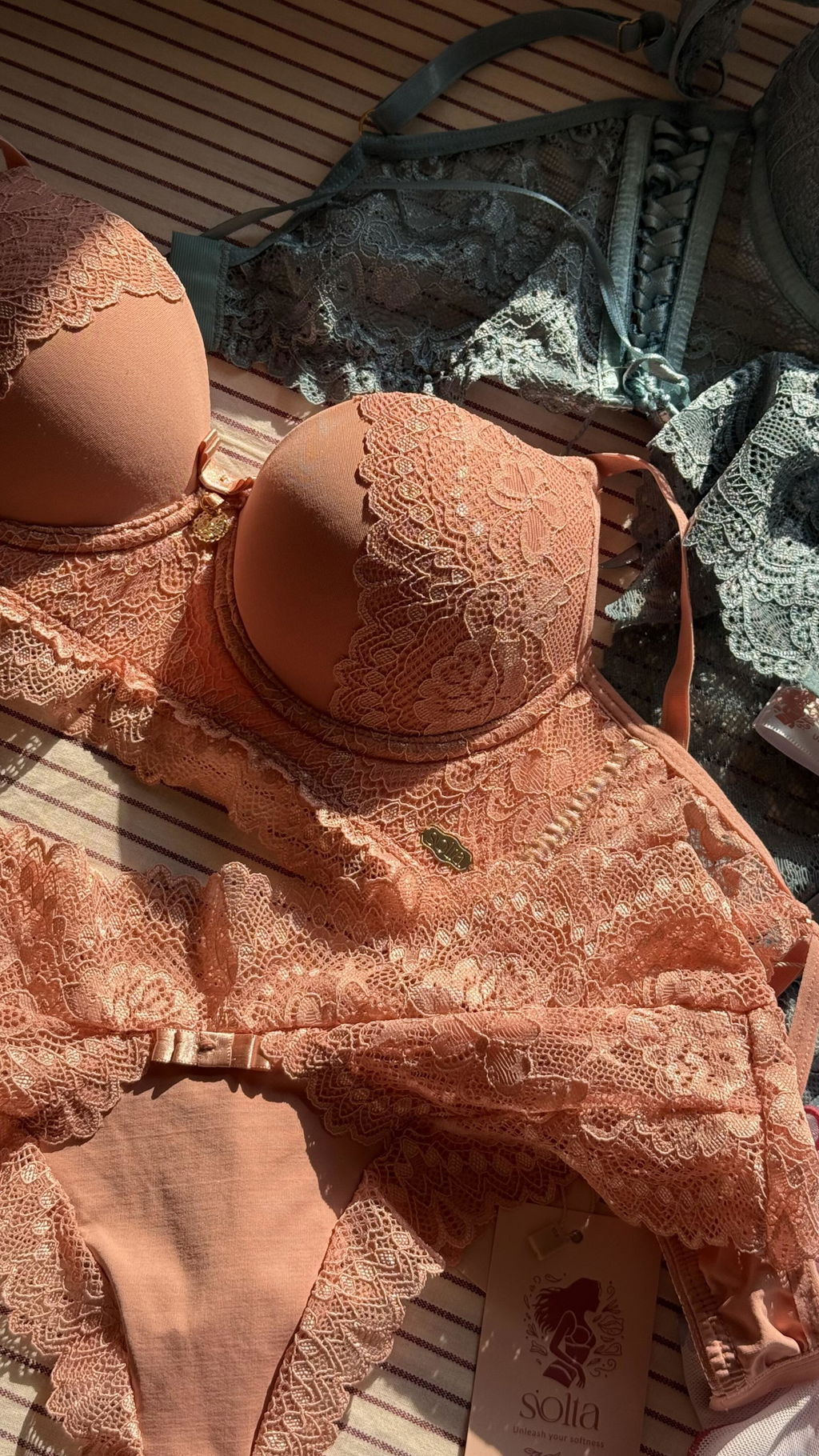
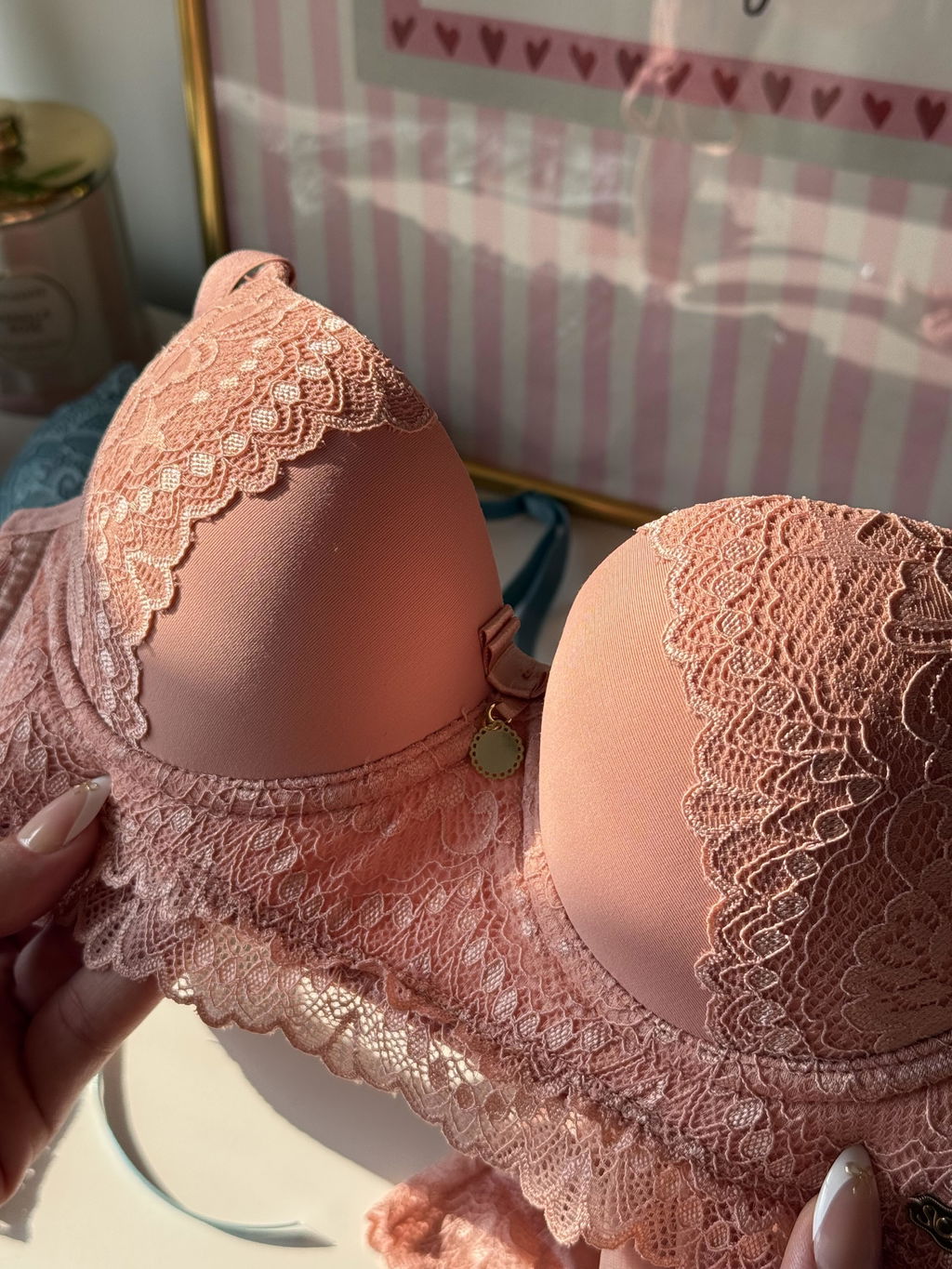
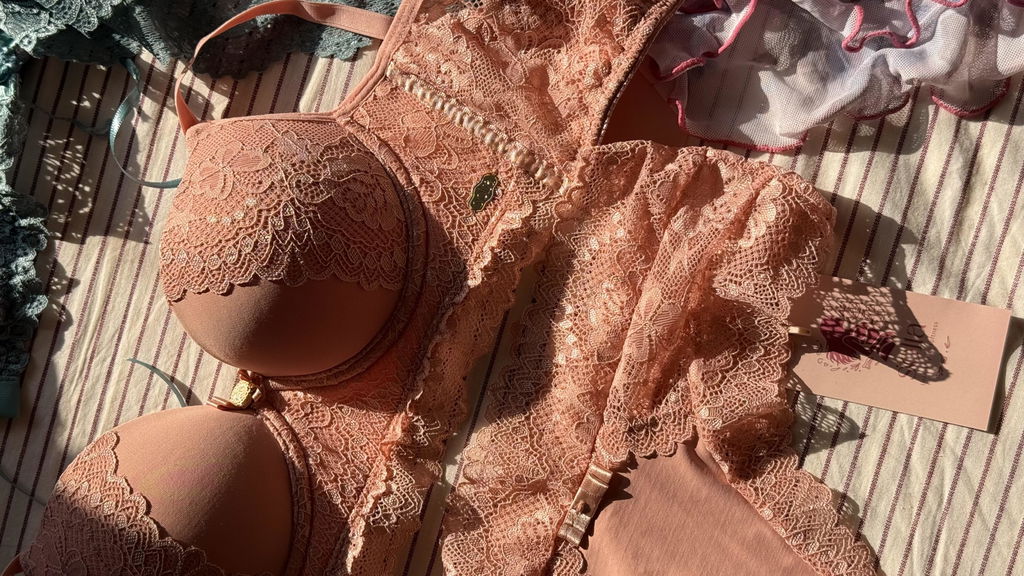
If the dress needs a bra and has straps or a covered back, a strapless in a smooth fabric is the usual answer. Ours is Serena, a strapless in premium microfibre with a matching Brazilian knicker, and it comes in the same nude so the two pieces read as one thing rather than two.
Another honest note. Most of our bras are underwired, which is what gives the shape under a fitted bodice. If you want to spend the day with no wire at all, Willow is the one in our range built that way, and it is a bralette rather than a support bra. Know which of those two things you are buying.
For a plunge neckline, look for a deep V rather than a push up, because a push up creates a horizontal line exactly where a plunge dress is open. For a backless dress, adhesive cups are the only real option, and the guides are right that they take practice. Buy them early and wear them for a full evening before the wedding, not for the first time on the morning.
Shapewear, honestly
Shapewear is a preference, not a requirement, and the industry is not neutral about it because the industry sells it.
If you want it, two things are worth knowing. Go lighter than you think, because very firm compression under a fluid dress creates its own ridges at the top and bottom edge. And if your dress is corseted, you may be adding a second structure on top of one that already works, which tends to make you less comfortable without making you look any different.
What to take to the fitting, and to dress shopping
These are two different trips and they need different things.
For dress shopping, when you are trying on many dresses quickly in front of a consultant, wear smooth nude underwear with no lace, a strapless bra if you normally wear one, and nothing that leaves marks. You will be undressing and dressing repeatedly, so comfort matters more than anything.
For the final fitting, wear exactly what you intend to wear on the day. Not something similar. The seamstress is setting a hem and taking in a bodice around whatever is under it, and a difference of a few millimetres in a band changes where the dress sits.
Then do one thing most brides skip. Have someone photograph you in the dress, with flash, from behind. Flash is what reveals a line, and the back is where you cannot check yourself in a mirror. Better to find it in a fitting room than in your own wedding album.
After the dress comes off
The dress is for the photographs. The morning before it and the night after it are yours, and they tend to get planned last.
If you want something for the getting ready pictures, a long robe hangs better on camera than a short one and keeps you covered while someone works on your hair. Ours live in bridal robes and dressing gowns, in white tulle and Chantilly lace.
The short version
Find out what your dress is made of. If it is crepe, go smooth and go Brazilian. If it is lace or tulle, wear what makes you happy. Try the dress with no bra before you buy one. Choose nude against your own skin rather than against the dress. Take the real pieces to the final fitting and photograph the back with flash.
Everything in this guide comes in S to XL with no fitting, and is made in Brazil, where the modelling for the Brazilian cut was developed. If you are between sizes, our size guide converts to UK, EU and US, and if you want to understand the cut itself, we explain it in what makes a knicker Brazilian.